
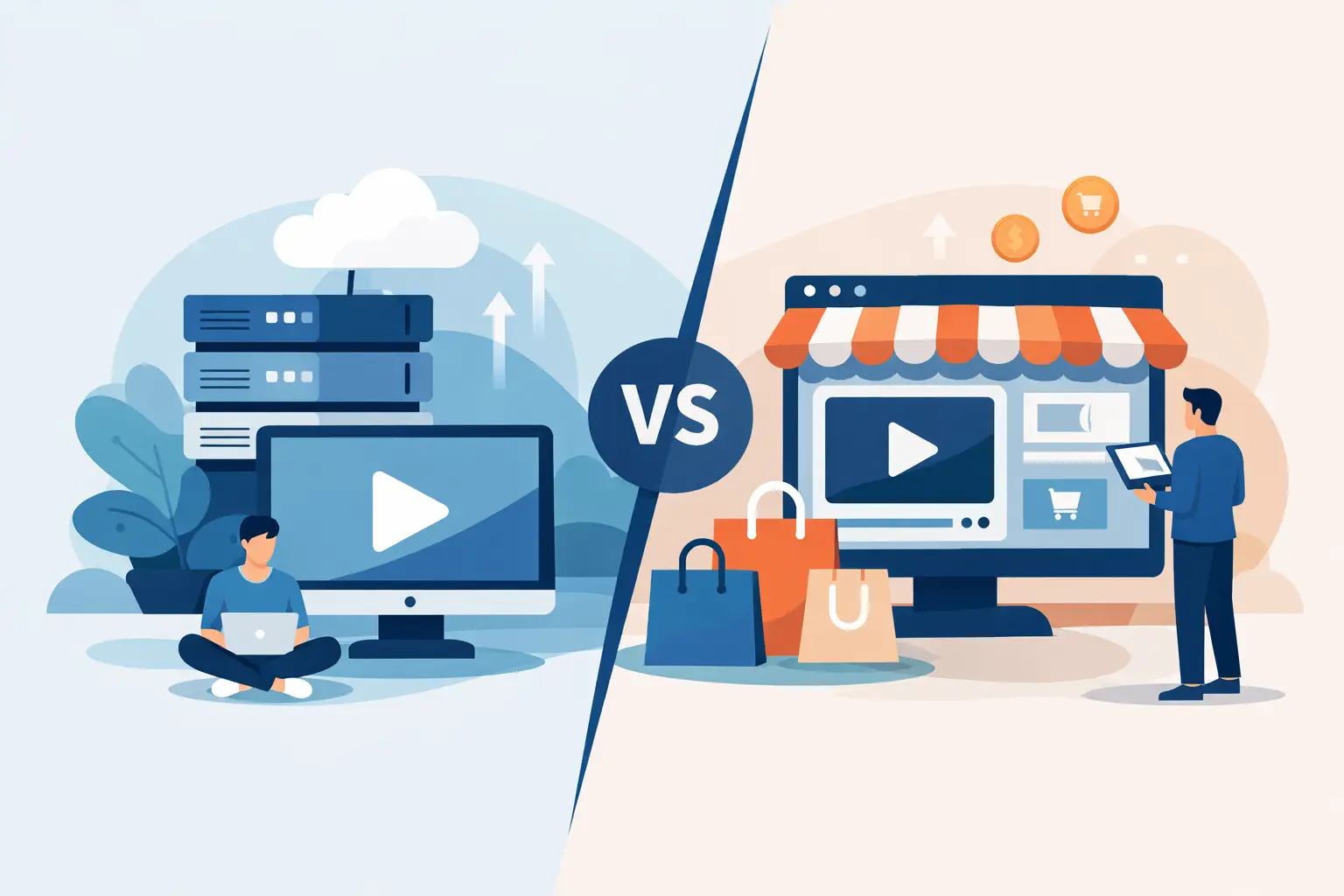
A marketplace can put your video in front of people quickly. But when a viewer pays through someone else’s platform, follows someone else’s rules, and receives someone else’s recommendations next, you are building on rented space. The decision around self hosted versus marketplace video is not just about where files live. It determines who owns the customer relationship, how you set prices, and what happens when your business grows.
For creators, publishers, educators, and media brands, the right answer depends on what you want video to do. If video is primarily a discovery tool, a marketplace may be useful. If video is a product, a membership benefit, or the centre of your business, your own video platform usually gives you more room to build.
What separates self-hosted and marketplace video?
A video marketplace is a third-party destination where creators publish content within a shared ecosystem. The platform controls the viewing environment, payment process, rules for accepted content, search visibility, and often the customer data available to you. Depending on the marketplace, it may also set the revenue split, limit pricing options, or place competing videos directly beside yours.
A self-hosted video business operates through your own website. In practical terms, this often means using WordPress to present your video library, restrict access, sell memberships or individual videos, and manage customer accounts under your own brand. You choose the structure, the catalogue experience, the pricing, and the payment flow.
This does not mean a self-managed platform has to be difficult to operate. It means you take responsibility for the decisions that shape your service. For business owners who want a long-term asset rather than a profile on another platform, that responsibility is usually a feature, not a drawback.
When a marketplace is the right starting point
Marketplaces are not automatically the wrong choice. They can be useful when speed and existing traffic matter more than control. A new filmmaker testing demand for a single release, for example, may benefit from placing it where viewers are already browsing. A course creator with no audience might use a marketplace to validate a topic before investing in a full catalogue.
They also reduce some operational work. The marketplace may handle customer checkout, tax settings, streaming delivery, support expectations, and promotions. That can make the first sale easier, especially when your business model is still taking shape.
The trade-off appears after the sale. You may not fully control the customer relationship or be able to market directly to purchasers. Your content can be affected by changing policies, rising fees, altered algorithms, or a platform decision that puts its own priorities ahead of yours. A marketplace may help you find an audience, but it is rarely the best place to build your entire business around that audience.
Why self-hosted video gives platform owners more control
A self-hosted platform is built around your business, not a marketplace’s business model. Your website becomes the place where viewers discover programming, create accounts, purchase access, and return for the next episode.
Your brand stays at the centre
On a marketplace, your video page lives inside the marketplace’s interface. Its navigation, recommended content, policies, and promotions influence the viewing session. On your own website, viewers experience your branding from the first visit through checkout and beyond.
That matters for premium content. A fitness studio can organize programs by goal and difficulty. A production company can build a catalogue around series, seasons, trailers, and featured releases. A faith organization can create a member library that feels connected to its wider community. The platform supports the way your audience expects to browse, rather than forcing every business into the same listing format.
You set the monetization model
The biggest commercial advantage in self hosted versus marketplace video is flexibility around revenue. Marketplaces often prefer one payment model. Your own platform can support recurring subscriptions, memberships, one-time purchases, and limited-time rentals based on the content and audience you serve.
A monthly membership may suit an educator adding new lessons every week. A rental can work for a new documentary or special event. A one-time purchase can make sense for a permanent training program, while a premium membership can combine an entire video library with other protected digital resources.
You can also test offers without waiting for marketplace approval. Adjust prices, create member-only collections, offer annual plans, or package a complete series. The point is not to use every pricing model at once. It is to keep the option to choose the model that fits your product.
You own the customer journey
When someone becomes a customer on your website, you can guide what happens next. You can show them related series, promote an upcoming release, invite them into a higher membership tier, or make it easy to continue watching. Those moments build retention, which is often more valuable than chasing a constant stream of first-time buyers.
Direct ownership also gives you a clearer view of what your customers want. You can see which collections attract sign-ups, which episodes keep members engaged, and which offers lead to renewals. A marketplace may provide some reporting, but it will always prioritize the marketplace’s relationship with the buyer.
The operational trade-off is real
Self-hosted does not mean free, automatic, or entirely hands-off. You need a domain, WordPress hosting, video delivery arrangements, payment processing, and a plan for customer support. You are responsible for keeping your site maintained and making sound choices around plugins, updates, and access rules.
For many businesses, those are reasonable operating costs because they support an owned revenue channel. Still, a self-managed platform is not the best first move for every creator. If you have one video, no clear offer, and no plan to reach viewers, a marketplace can be a lower-risk way to test interest.
The question is whether you are avoiding unnecessary complexity or postponing the platform your business will eventually need. Once you have recurring programming, a growing mailing list, or customers asking for direct access, relying only on a marketplace can become the more limiting option.
Build for the way your library will grow
Video businesses often start with a single product and become more complex quickly. One course becomes a collection of modules. A pilot episode becomes a season. Weekly classes become an on-demand library. Your platform should make that growth easier to manage.
WordPress is a practical foundation because it gives you control of your website while keeping content management familiar. With WP Video Subscriptions, platform owners can create a Netflix-style browsing experience, organize TV shows and episodes, restrict premium content, and collect payments directly through their WordPress site. The goal is not to commission a custom streaming application before you are ready. It is to create your own video subscription website with the tools to sell, organize, and expand.
A polished structure also changes how viewers perceive the value of your content. Clear collections, series pages, episode navigation, and protected member areas make a video library feel like a service worth returning to. That experience is especially important when you are asking customers to subscribe rather than make a one-time purchase.
A hybrid approach can work well
You do not always have to choose one channel forever. Some businesses use marketplaces, social platforms, or public video channels to reach new viewers while keeping their premium library on their own site. A short free lesson can introduce an instructor. A trailer can create interest in a series. A public clip can lead viewers toward the full paid experience.
The key is to give each channel a job. Use external platforms for awareness when they help, but keep your highest-value content, memberships, and customer relationships on the platform you control. Do not let discovery channels become the only place customers can buy from you.
Choose based on the business you want to own
If your priority is immediate exposure for a small catalogue, a marketplace may be a sensible starting point. If your priority is recurring revenue, flexible offers, a branded viewer experience, and direct customer relationships, self-hosted video is the stronger foundation.
Think beyond your next upload. Build the place where you want your best viewers to return, where your content can be organized properly, and where every new member strengthens a platform that belongs to you.
